MOPairIter gives the ordering of orbital pairs. More...
#include <pairiter.h>
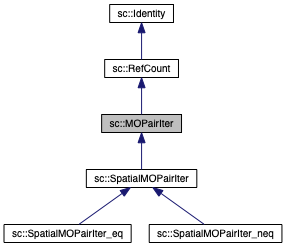
Inheritance diagram for sc::MOPairIter:
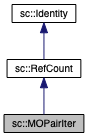
Collaboration diagram for sc::MOPairIter:
Public Member Functions | |
| MOPairIter (const Ref< MOIndexSpace > &space_i, const Ref< MOIndexSpace > &space_j) | |
| Initialize an iterator for the given MO spaces. | |
| virtual void | start (const int first_ij=0)=0 |
| Start the iteration. | |
| virtual void | next ()=0 |
| Move to the next pair. | |
| virtual | operator int () const =0 |
| Returns nonzero if the iterator currently hold valid data. | |
| int | ni () const |
| Returns the number of functions in space i. | |
| int | nj () const |
| Returns the number of functions in space j. | |
| int | i () const |
| Returns index i. | |
| int | j () const |
| Returns index j. | |
| int | nij () const |
| Returns the number of pair combinations for this iterator. | |
| int | ij () const |
| Returns the current iteration. | |
 Public Member Functions inherited from sc::RefCount Public Member Functions inherited from sc::RefCount | |
| int | lock_ptr () const |
| Lock this object. | |
| int | unlock_ptr () const |
| Unlock this object. | |
| void | use_locks (bool inVal) |
| start and stop using locks on this object | |
| refcount_t | nreference () const |
| Return the reference count. | |
| refcount_t | reference () |
| Increment the reference count and return the new count. | |
| refcount_t | dereference () |
| Decrement the reference count and return the new count. | |
| int | managed () const |
| void | unmanage () |
| Turn off the reference counting mechanism for this object. More... | |
| int | managed () const |
| Return 1 if the object is managed. Otherwise return 0. | |
| Public Member Functions inherited from sc::Identity | |
| Identifier | identifier () |
| Return the Identifier for this argument. More... | |
Protected Attributes | |
| bool | i_eq_j_ |
| int | ni_ |
| int | nj_ |
| int | i_ |
| int | j_ |
| int | nij_ |
| int | ij_ |
Additional Inherited Members | |
| Protected Member Functions inherited from sc::RefCount | |
| RefCount (const RefCount &) | |
| RefCount & | operator= (const RefCount &) |
Detailed Description
MOPairIter gives the ordering of orbital pairs.
The documentation for this class was generated from the following file: