RedundantCartesianIter objects loop through all possible combinations of a given number of axes. More...
#include <cartiter.h>
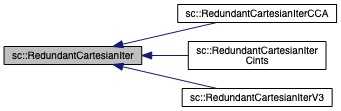
Inheritance diagram for sc::RedundantCartesianIter:
Public Member Functions | |
| RedundantCartesianIter (int l) | |
| Create a object for the given angular momentum. | |
| virtual int | bfn ()=0 |
| Return the current Cartesian basis function number. | |
| void | start () |
| Initialize the iterator. | |
| void | next () |
| Move to the next combination of axes. | |
| operator int () | |
| Returns nonzero if the iterator currently hold valid data. | |
| int | a () |
| The current exponent of x. | |
| int | b () |
| The current exponent of y. | |
| int | c () |
| The current exponent of z. | |
| int | l () |
| The angular momentum. | |
| int | l (int i) |
| Returns a() if i==0, b() if i==1, and c() if i==2. | |
| int | axis (int i) |
| Return the i'th axis. | |
Detailed Description
RedundantCartesianIter objects loop through all possible combinations of a given number of axes.
This is used to compute the transformation matrices that maps a set of Cartesian functions to another set of Cartesian functions in a rotated coordinate system.
The documentation for this class was generated from the following file: